
‘Fashions in medicine are on a par with fashions in dress’ – William White, 1885.
Radio broadcaster Jeni Barnett recently admitted on live radio that she did not give her children the MMR vaccine and she proceded to have a 45 minute discussion about why not.
Immediately afterwards, angry medical professionals telephoned her, she had people posting on her blog about what a bad mother she was and she’s even had the threat of legal action, simply for saying why she didn’t get the MMR. Whatever happened to free speech? The DOH are constantly putting out articles and TV appeals about how great MMR is, and predicting how many people are going to die if they don’t line up for the vaccine, yet not one of the people who have chosen not to vaccinate have ever threatened them with legal action for withholding information from the public or scaring them with fatality predictions! If they are allowed to publically state their case for MMR, then so should people who question the vaccines, including medical professionals like Andrew Wakefield and Jayne Donegan.
So where is this going? And what has it to do with stupid medical advice?
Since the inception of medical practices, there have been many treatments which were thought to be as vital and necessary as vaccination, which were subsequently found to be harmful. Any person questioning the treatment would first be ridiculed, then there would be fierce opposition to him and a string of medical studies to back up the treatment. Finally, after many years, the medical profession would concede that in fact, it was harmful.
Examples of Medical Practices Which Were Scientifically ‘Proven’, Which Were Later Abandoned
Blood letting has to be the most obvious one.
Blood letting began in 1,000 BC. Doctors of that time thought that sickness was caused by evil spirits and that to expell the spirit from the body and get rid of the illness, you had to release the spirit by bleeding.
The practice was continued right up until the late 19th century to help people recover from illnesses. Doctors of the 19th century thought a lot of conditions were caused by emotional problems and thought blood letting would strengthen a person’s psychological outlook.
Despite it’s 3,000 history it was debunked as rubbish by the very people who had been practicing it for years.
The instrument used to perform blood letting was called the Lancet, which is what the UK’s famous medical journal is named after. (for more info on blood letting, see http://www.pbs.org/wnet/redgold/basics/bloodletting.html).
Vaccination has been around about 300 years, which is a tiny blip in time compared with the 3,000 year history of blood letting.
Another example of stupid medical advice is smoking.
Tabacco leaves were first discovered in 1492. By 1518 it was documented that native Americans were smoking it and by 1531 it began to be commerically farmed.
In 1930’s, medical journals actually advertised cigarette smoking with slogans like:
‘“We advertise KOOL cigarettes simply as a pleasant combination of fine tobaccos made even more pleasant by the cooling sensation of menthol. They won’t cure anything. They won’t harm anybody. They will prove enjoyable.”
In addition to medical journals of the time stating that cigarettes won’t harm you, the companies that made cigarettes, made amazing claims such as cigarette smoking will ease a sore throat and doctors choose our cigarettes so they must be good for you. It seems similar to the aggressive advertising for MMR vaccine and the pronouncement by the drug companies and doctor’s that it’ll protect your child’s health.
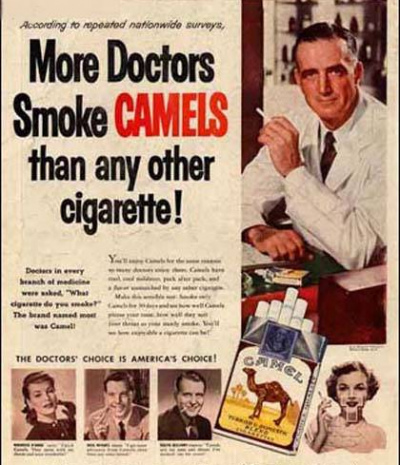
In the 1940’s, the first studies on smoking and lung cancer began to emerge and there were a rush of journal articles, some showing a link and then other’s rushing to the defence of cigarettes, by proclaiming that cigarettes DID NOT cause lung cancer.
This same yo-yo effect is seen with MMR. You have a study showing that there are ASD’s after vaccination, followed by another three or four saying MMR is safe, and dire predictions of what will happen to our children if we don’t vaccinate, all sponsored by the industry that make them.
Copy and paste this link to see the TV advert for Camels! http://www.youtube.com/watch?v=gCMzjJjuxQI
Do You Know Where The Term ‘Cutting Teeth’ Comes From?
It may surprise you to learn that in centuries past, doctors would actually cut the gum of a baby to allow the teeth to come through. They called this process ‘teething’ and that is where the term cutting teeth originated from.
Many babies died from this procedure. In the year 1842, a staggering 4.8% of all babies under 1 year of age died from ‘teething’, according to the British Registrar General’s office. An additional 7.1% of toddlers aged between 1 and 3 years also died – usually because of secondary infections associated with cutting the gums.
Despite its high death rate, the practice had persisted for centuries.
It was begun by French surgeon Ambriose Pare, in 1575, after he examined a dead child. He said
“When we diligently sought for the cause of his death, we could impute it to nothing else than the contumacious hardness of the gums…when we cut the gums with a knife we found all the teeth appearing…if it had been done when he lived, doubtless he would have been preserved.’
By 1850 the medical profession believed so strongly in the practice of ‘teething’ that they referenced it in books such as Diseases of Children.
Just like with vaccination, there were many medical professionals who disagreed with cutting teeth and at a Medical Society of London meeting held in 1884, surgeon Edmund Owen from the Hospital for Sick Children, said that the practice of cutting teeth should ‘lie in a tomb alongside leaching’. Other doctors at the meeting vehmently disagreed with him, and a doctor Samuel Gross complained that younger generation doctors were not using their lancets.
The practice was also performed in the USA, and deaths from ‘teething’ are recorded in the United States Census, 1850-1870. A newborn, ONE MONTH old baby boy, George, was sadly listed as dying from ‘teething’.
Cutting teeth was not abandoned until the beginning of the 20th century.
Sources: British Dental Journal 191, 4 – 8 (2001), Utah Education Network lesson plan, a death record: 1860.
Dish out Those Cough and Cold Medicines….Except Don’t!
For years and years, the advise was if your child has a cough or cold, treat it with cough and cold medicines. My mother was lightening fast at dishing out the disgusting tasting pharmaceutical goo every time we so much as sneezed….then….the FDA wanted to ban them for under 3 year old’s and the UK MHRA reported that the Commission on Human Medicines had banned them for under 6 year old’s, stating:
‘Over-the-counter (OTC) cough and cold medicines for children have been under review in the UK.
The Commission on Human Medicines (CHM) has advised on a package of measures to improve safe use of cough and cold medicines for children under 12.
The new advice is that parents and carers should no longer use over-the-counter (OTC) cough and cold medicines in children under 6. There is no evidence that they work and can cause side effects, such as allergic reactions, effects on sleep or hallucinations.’
The summary of research stated:
‘The symptoms of cold are the body’s natural defence against the virus. In some
circumstances treatment of symptoms, even if effective, may not be desirable, since this
could reduce the body’s capacity to deal with the virus.’
This is something enlightened doctors, holistic practitioners and naturally minded parents have been telling the medical profession for YEARS but we got scoffed at and called ‘quacks’.
http://www.mhra.gov.uk/home/groups/pl-p/documents/websiteresources/con041374.pdf and http://www.mhra.gov.uk/Safetyinformation/Safetywarningsalertsandrecalls/Safetywarningsandmessagesformedicines/CON038908
High Carb, Low Fat Diet Keeps you Slim – or Does It?
For decades the governments of the world have said that eating a high carb, no fat diet is good for you and that it will keep you thin and prevent heart disease and obesity. I have to admit, I fell for their advice here. Being a health conscious vegetarian it seemed obvious that you would be slim if you ate less fat.
But actually doctors are only now realizing that if you are lacking in fats and proteins (protein helps you feel ‘full’ for longer) your brain will cry out for them, making you want to snack more, eat junk food and have bigger portion sizes. So if you eat more good fats and more protein you’ll be less hungry and stay slimmer.
One would imagine that prior to giving us the high carb, low fat advice and implementing it on a mass scale, the governments would actually have some evidence behind their recommendation? Turns out they don’t.
According to the journal Nutrition:
‘Concerns that were raised with the first dietary recommendations 30 y ago have yet to be
adequately addressed. The initial Dietary Goals for Americans (1977) proposed increases in
carbohydrate intake and decreases in fat, saturated fat, cholesterol, and salt consumption that are carried further in the 2010 Dietary Guidelines Advisory Committee (DGAC) Report. Important aspects of these recommendations remain unproven, yet a dietary shift in this direction has already taken place even as overweight/obesity and diabetes have increased.’
So much for science based medicine, then.
Although this diet hasn’t been consigned to the history books yet, more and more evidence is surfacing to show it isn’t actually good for us so I believe it will be scrapped one day.
http://www.spfldcol.edu/homepage/dept.nsf/91C8B01CAAC804C0852577C9006A5012/$File/Hite_Nutrition_2010.pdf
Sunlight Makes You Have Cancer
Another totally stupid piece of medical advice is the teaching that sunlight will cause you to have skin cancer and you must plaster yourself in sun screen every time you go out.
Trying to get a sun tan, lying for hours in the sun and allowing yourself to get sunburn causes skin cancer, not merely absorbing sunlight.
After decades of promoting the use of sun screens, it has now been found that children are once again being diagnosed with the malnutrition disease rickets and people are getting fractures and brittle bones on an epidemic level. Why? Because the sun screen blocks out vitamin D absorption. Since the main source of vitamin D is from the sun, this is a disaster. Now they advise…er, actually you should go outside for 20 minutes a day with no sun screen. Duh!! This is something many practitioners in holistic circles have known for years.
http://www.dailymail.co.uk/health/article-2006035/Get-20-minutes-sun-day-help-beat-brittle-bones-say-MPs.html
The Telegraph reported:
‘The disease, caused by low levels of vitamin D generated in the body from sunshine and certain foods, had died out around 80 years ago but is now coming back.
Cases of rickets in children have occurred in northern England and Scotland where there are fewer months of the year with sufficient sunshine to obtain enough vitamin D but now doctors are seeing it on the South coast as well.
It is thought extensive use of sunscreen, children playing more time on computer games and TV rather than playing outside and a poor diet are to blame.’
http://www.telegraph.co.uk/health/healthnews/8128781/Middle-class-children-suffering-rickets.html
Because of their fear of the sun, the UK DOH have now started supplementing all under 5 year olds and pregnant mothers with vitamin D.
Stupid Medical Advice Continued
1. ROUTINE EPISIOTOMY – in the 1970’s when I was born, all women having a hospital birth were given episiotomies. My mother had one despite her first born being a month premature, as it was thought that a cut was ‘less painful’ than a natural tear. Studies proved this not to be the case and the practice of cutting all women was abandoned (see danger of episiotomy page). I hope to live long enough to see the whole barbaric practice abandoned.
2. Pregnant women were told to drink stout for ‘the iron’. Now they are told not to drink at all, or ‘only one or two glasses a week’.
3. After childbirth, women were told to stay in bed for two weeks. Now they are told to get up immediately to avoid blood clots.
4. Women were told to wean their babies onto solid food when they weighed 14lbs. By 1996 when I had my daughter, this advice was changed to 4 months of age. A couple of years ago, they changed the weaning advice to 6 months.
5. For decades they said co-sleeping with your baby was dangerous. When my son was born in 2007 I was given a leaflet by the health visitor, saying co-sleeping improves breast feeding outcomes and so you SHOULD co-sleep unless you smoke, take drugs or are on medication. (American Journal of Nursing:
January 2005 – Volume 105 – Issue 1 – pp 40-50 – and other studies similar).
6. My mother was told to put us to sleep on our front’s in the ‘recovery’ position to prevent cot death. Now they say put your baby to sleep on his back.
7. In the 1960’s they switched to using oral polio vaccine because of a rise in childhood cancer, associated with IPV. Recently, this was stopped and IPV reintroduced because the only polio since 1979 was caused by the vaccine.
‘ The last case of poliomyelitis in the United States due to indigenously acquired wild poliovirus occurred in 1979; however, as a consequence of oral poliovirus vaccine (OPV) use that began in 1961, an average of 9 cases of vaccine-associated paralytic poliomyelitis (VAPP) were confirmed each year from 1961 through 1989. To reduce the VAPP burden, national vaccination policy changed in 1997 from reliance on OPV to options for a sequential schedule of inactivated poliovirus vaccine (IPV) followed by OPV. In 2000, an exclusive IPV schedule was adopted.’
JAMA. 2004;292:1696-1701.
8. When measles vaccine and then MMR were introduced, we were told one shot was for life. Just a few years later they introduced a booster and now they are discussing whether we need three doses of MMR.
9. In 1978 my mother was told that a single measles shot would protect me from measles, so I had my vaccine. Now the DOH say that single measles jabs aren’t effective. Does that mean that they lied to my mother? She was following ‘proven science’ at the time.
My point being that all scientific hypothesis is just that: hypothesis. It is simply a popular idea which is thought to be true at the time. Many scientific ideas are later amended or changed, even after a study has ‘proven’ that they are safe, or the best method.
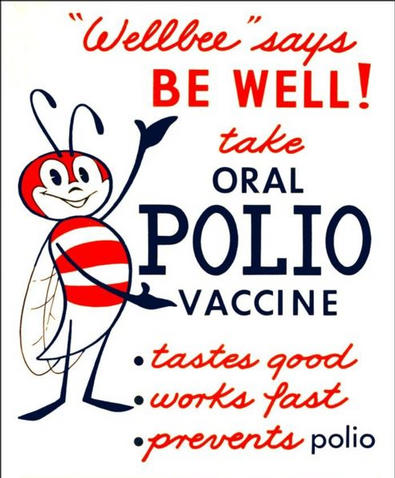
A 1963 Advertising Poster For Oral Polio Vaccine By The CDC. In 2000, They Stopped Using Oral Polio Vaccine Because It Was Causing Polio.
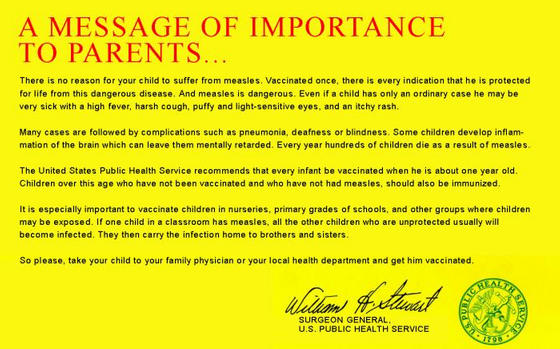
This is a late 1960’s notice from the Office of the Surgeon General, William H. Stewart, M.D, stating that one vaccination is all that is required for ‘life-long’ protection. Then They Introduced A Booster. Now They Say Antibodies Wear Off After 5 Years
(Elesvier Science LTD, Volume 13, Issue 16, 1995, Pages 1611-1616.). Now, the Advisory Committee on Immunization Practices Is Questioning Whether We Need 3 MMR’s
‘The list of therapeutic interventions that were once accepted but are now defunct is long enough to give one serious pause. For crying out loud, it took science decades to reach consensus that tobacco was bad for your health. Furthermore, bottle feeding with formula was once thought of as ‘scientific’ and modern and superior to breast feeding’ – Joseph Cooney, MD.
2 Comments